Fort Collins DUI First Offense Lawyer
A first DUI arrest in Fort Collins tends to catch people completely off guard. One moment you are leaving a Rams game at Canvas Stadium or heading home from a night out on College Avenue, and the next you are sitting in the back of a Larimer County Sheriff’s unit watching an officer prepare to search your car. The shock of that moment is real, but what happens in the days and weeks that follow matters far more than the arrest itself. A Fort Collins DUI first offense lawyer can make the difference between a conviction that follows you for years and a resolution that preserves your license, your record, and your future.
Colorado’s DUI laws carry real consequences even for a first offense. Conviction can mean jail time, mandatory public service hours, alcohol education classes, an ignition interlock device on your vehicle, probation, and a criminal record that will appear on background checks for employment, housing, and professional licensing. The DMV process runs on a completely separate track from the criminal case, and it moves fast. Drivers who do not request a DMV hearing within seven days of their arrest can lose their license automatically before ever setting foot in court.
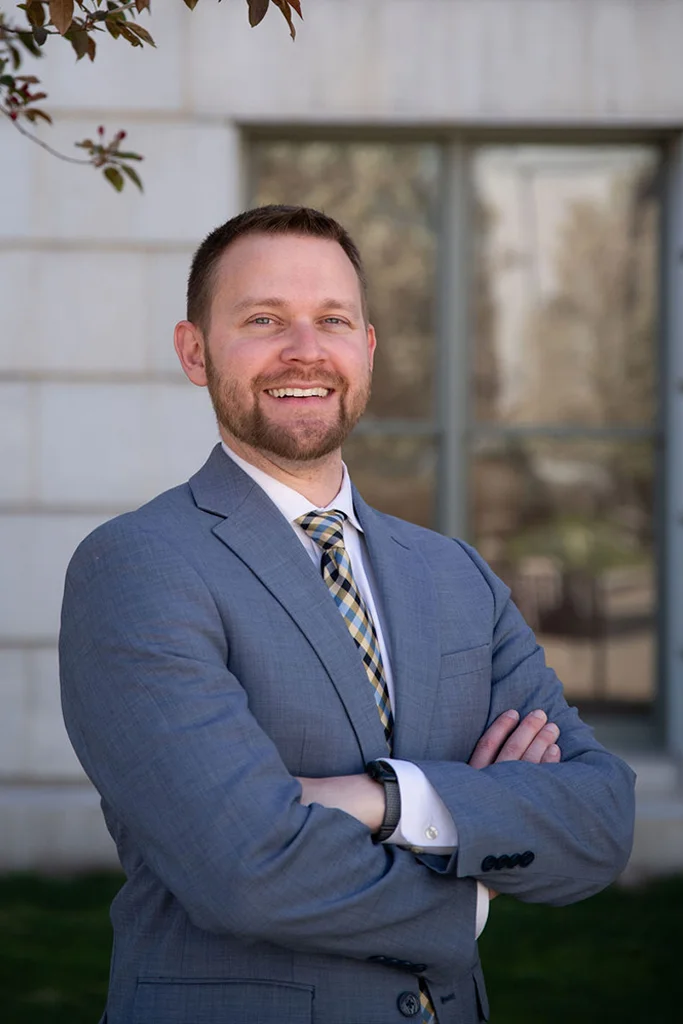
Reid DeChant has handled DUI cases across northern Colorado and the Front Range, and his approach goes well beyond filing motions and waiting for a plea offer. As a former public defender who trained at the Trial Lawyers College, Reid understands how these cases are actually built by law enforcement, where the weaknesses appear, and how to tell your story to a judge or jury in a way that produces results. If your case was filed in Larimer County, you want a defense attorney who knows this courthouse, these prosecutors, and how these cases play out in this specific jurisdiction.
What a First DUI Offense in Larimer County Actually Involves
Fort Collins sits in Larimer County, and most DUI cases arising from arrests in the city or along U.S. 287, Highway 14, or I-25 are prosecuted in the Larimer County District Court or the Larimer County Combined Court in Fort Collins. The Larimer County District Attorney’s Office handles these cases, and understanding how that office approaches first-time DUI defendants is critical to building a realistic strategy.
Colorado distinguishes between DUI and DWAI, which stands for Driving While Ability Impaired. A blood alcohol concentration of 0.08 or higher typically results in a DUI charge, while a BAC between 0.05 and 0.079 can support a DWAI charge. Both are criminal offenses, though they carry different penalty ranges. A first-offense DUI in Colorado can result in up to one year in jail, though most first offenders do not serve anywhere near that maximum. Courts often consider probation, public service, and alcohol education programming as components of the sentence. However, the outcome you get depends heavily on the facts of your stop, the quality of the evidence, and how your defense is presented.
The chemical test results are often treated as the central piece of evidence, but they are not infallible. Breathalyzer calibration records, the officer’s administration of the test, the timing of the test relative to when you were driving, and whether law enforcement properly followed the Express Consent advisement procedures can all affect whether the results are admissible or reliable. Colorado’s Express Consent law requires officers to provide specific advisements before requesting a chemical test. Cases have been dismissed when those advisements were given improperly or at the wrong time, including multiple results listed on DeChant Law’s own case record.
Charge Categories and Defense Angles Relevant to Fort Collins DUI First Offense Cases
- Standard BAC DUI: Charges under Colorado’s per se DUI statute apply when a breath or blood test shows a BAC at or above 0.08, but the accuracy of that result is frequently challenged through calibration logs, maintenance records, and the conditions under which the test was administered.
- DWAI: A DWAI charge requires less proof of impairment than a full DUI, and BAC levels as low as 0.05 can support the charge. For some defendants, negotiating a first DUI down to a DWAI is a meaningful outcome because the penalties differ and the stigma on a record is reduced.
- DUI-Drugs: Colorado criminalizes driving under the influence of any drug, including marijuana, prescription medications, and controlled substances. Drug DUI cases in Fort Collins are more complex because there is no simple numeric threshold equivalent to the alcohol per se standard. Impairment must be demonstrated through officer observation, field sobriety testing, and often drug recognition expert testimony, all of which can be challenged.
- Express Consent and DMV License Revocation: When you are arrested for DUI in Colorado, the Department of Revenue initiates an administrative proceeding that is entirely separate from the criminal case. You have seven days to request a hearing. Failing to request that hearing means your license is revoked automatically. A Fort Collins DUI attorney can request and litigate that hearing, and many drivers have had revocations dismissed through proper advocacy at the DMV level.
- Field Sobriety Test Challenges: Standardized field sobriety tests have specific protocols that officers must follow. The Walk and Turn, One Leg Stand, and Horizontal Gaze Nystagmus tests are only reliable when administered correctly. Fatigue, footwear, uneven pavement, nerves, and physical conditions can all affect performance and give rise to legitimate challenges to the arresting officer’s observations.
- Unlawful Traffic Stops: The entire chain of evidence in a DUI case begins with the initial traffic stop. If the officer lacked reasonable suspicion to pull you over, everything gathered after that point, including breath results and field sobriety test performance, may be subject to suppression. Checkpoints have their own legal requirements that must be strictly followed.
- Rising BAC Defense: Alcohol continues to absorb into the bloodstream for a period after drinking stops. If the test was administered an hour or more after you were actually driving, your BAC at the time of driving may have been lower than the result suggests. This is a scientifically grounded defense that applies in appropriate cases.
What to Do After a Fort Collins DUI Arrest
The first thing to do after a DUI arrest in Fort Collins is stop talking to investigators. Law enforcement officers are trained to gather evidence, and anything you say will be documented and potentially used against you. This is not about being uncooperative. It is about protecting yourself from statements that can be taken out of context or that fill in gaps the prosecution might not otherwise be able to prove. You have the right to remain silent, and you should exercise it immediately and without apology.
The DMV deadline matters more than almost anything else in the first week. Once you receive notice of the administrative action against your license, a seven-day window opens. If you do not request a DMV hearing within that period, the revocation becomes automatic regardless of what happens in the criminal case. Your attorney can initiate this request on your behalf, but they need to be retained quickly. Waiting even a few days can eliminate this option entirely.
Gather and preserve everything you can remember and document. Write down the sequence of events while your memory is sharp: where you were, what you consumed, when you stopped, what route you took, how long you drove, what the officer said, and how the stop unfolded. This information may seem minor now but can become critical when cross-examining the arresting officer months later. If you were pulled over near specific landmarks such as Mulberry Street, Harmony Road, or any of the commercial areas along College Avenue, note that as well. Specifics matter.
Your criminal case will be heard at the Larimer County Combined Court, located at 201 LaPorte Avenue in Fort Collins. First appearances typically happen quickly, and this is where bail, release conditions, and future hearing dates are set. Having an attorney present at the first appearance can affect what conditions the court imposes and signals to the prosecution that you are taking the case seriously. Courts treat represented defendants differently, and that difference begins at the very first hearing.
Avoid the common mistake of assuming a first offense will resolve itself with minimal consequences. Many people treat the first court appearance as a formality or accept plea offers before anyone has reviewed the evidence. Police reports can contain errors. Chemical test results can be challenged. Officers sometimes fail to follow required procedures. None of that becomes visible unless someone actually reviews the evidence with care. A Fort Collins DUI attorney earns their fee most visibly in those early weeks by doing the work that identifies where the case can be challenged before you ever enter a plea.
Why Reid DeChant Is the Right Choice for a Larimer County DUI Defense
Reid DeChant built his practice on the kind of trial-heavy experience that genuinely changes how a lawyer reads a DUI case. As a former public defender in Denver, Broomfield, and Adams County courtrooms, Reid handled an enormous volume of criminal cases, including DUI and DWAI charges at every stage from first appearance through jury trial. That repetition, facing prosecutors, cross-examining police officers, and arguing motions in front of judges, is what separates lawyers who know DUI law in the abstract from those who know how these cases actually behave inside a courtroom.
Reid is also a graduate of the Trial Lawyers College, the program founded by legendary defense attorney Gerry Spence. The college trains lawyers not just in legal theory but in storytelling, authentic human connection, and the kind of courtroom presence that persuades real juries. For a DUI defendant who may end up in front of a Larimer County jury, that distinction is not academic. Juries respond to attorneys who present their clients as complete human beings rather than as defendants to be processed. Reid’s training shapes how he prepares for trial, how he cross-examines witnesses, and how he presents your side of the story at every stage of the proceedings.
DeChant Law’s published case results include multiple DMV Express Consent actions dismissed at the administrative level, DUI charges dismissed outright, and DUI defendants who received Not Guilty verdicts at trial in counties including Jefferson, Arapahoe, and Douglas. Past outcomes do not guarantee future results, but they reflect a pattern of building cases with enough rigor to succeed in the most demanding environments. Reid maintains membership in the National Association of Criminal Defense Lawyers and the Colorado Criminal Defense Bar, keeping his strategy current and connected to the best defense thinking available.
Questions People Ask About First-Offense DUI in Fort Collins
Will I go to jail for a first DUI in Colorado?
Jail time is possible but not guaranteed for a first offense. Colorado’s statutes allow for up to one year in jail for a first DUI conviction, but courts frequently impose alternative sentences that include probation, public service hours, alcohol education classes, and an ignition interlock requirement rather than incarceration. The actual outcome depends on the facts of your case, your prior record, whether there were any aggravating factors, and how the case is defended.
Can a first DUI be reduced or dismissed in Larimer County?
Yes. Reductions and dismissals happen regularly, particularly when the defense identifies problems with the evidence. Cases get dismissed when stops lacked legal justification, when chemical test results are unreliable, or when the Express Consent advisement was not properly given. Reductions from DUI to DWAI occur in cases where the evidence of impairment is not overwhelming and where counsel negotiates effectively. Neither outcome is guaranteed, but both are real possibilities when the case is properly worked.
What is the DMV hearing and why does it matter?
The DMV hearing is a separate administrative proceeding brought by the Colorado Department of Revenue to revoke your driver’s license. It runs on its own timeline, independent of the criminal case. You have seven days from arrest to request this hearing. If you miss the window, your license is revoked automatically, even if you ultimately win the criminal case. The DMV hearing is also an opportunity to gather information from the arresting officer under oath, which can assist the criminal defense.
What happens to my license after a first DUI arrest in Colorado?
Your license faces two separate threats. The DMV can revoke it administratively based on the chemical test results or your refusal to submit to testing. The criminal court can also impose a license suspension as part of sentencing. Requesting and winning the DMV hearing can preserve driving privileges during the criminal case. An ignition interlock device is typically required at some point in the process, allowing you to drive with a restricted license while the interlock is installed.
Should I refuse the breath or blood test if I am pulled over?
Colorado’s Express Consent law means there are real consequences to refusal, including license revocation and the potential for the refusal itself to be used as evidence. Refusing does not prevent prosecution, and it removes the possibility of challenging an inaccurate result. The decision involves tradeoffs that depend heavily on the facts of the specific stop, which is why this is a question worth discussing with a defense attorney rather than relying on general advice.
Does a DUI conviction in Colorado affect a professional license?
For many licensed professionals, including nurses, teachers, contractors, and others holding state-issued licenses, a criminal conviction requires disclosure to licensing boards. How a board responds varies by profession and by the circumstances. Some boards treat first-offense DUI as a minor matter; others impose discipline or require hearings. If you hold a professional license, the licensing consequences can rival the criminal penalties in significance, and that reality should factor into how aggressively you defend the criminal case.
Can I get a DUI expunged from my record in Colorado?
Colorado’s expungement and sealing laws are generally more restrictive for criminal convictions than for arrests that did not result in conviction. A DUI conviction for an adult is not expungeable under current Colorado law. Charges that were dismissed or resulted in acquittal are typically eligible for sealing. This is one reason why the outcome of a first DUI case matters so much. A conviction leaves a permanent mark, while a dismissal or not-guilty verdict opens the door to having the record sealed.
How long does a first DUI case typically take in Larimer County courts?
The timeline depends on whether the case proceeds to trial or resolves through a plea. Cases that settle take months from arrest to resolution. Cases that go to trial can take considerably longer, often extending well past a year. The Larimer County Combined Court has its own docket pressures and scheduling patterns. An attorney who has litigated cases in this jurisdiction understands those rhythms and can give you a realistic sense of how your case is likely to move through the system.
What is the difference between a DUI and a DWAI in terms of long-term consequences?
Both are criminal convictions in Colorado, but DWAI carries somewhat lighter penalties. A DWAI conviction adds points to your driving record but the number differs from a full DUI. For licensing boards and background check purposes, both appear as criminal convictions, but the specific charge designation can matter in how employers and regulators perceive the record. Negotiating a reduction from DUI to DWAI, when the evidence supports it, is a legitimate goal even if it does not eliminate all consequences.
Can the arresting officer’s observations be challenged if my BAC was above the legal limit?
Yes. Colorado law allows prosecution on two separate theories: the per se BAC threshold and actual impairment. But even when the BAC result is technically above 0.08, the defense has options. Reliability challenges to the testing equipment, rising BAC arguments, improper test administration, and chain of custody issues can all affect how the evidence is received. In some cases, even a result above the threshold can be successfully challenged at trial or suppressed through a pretrial motion, changing the entire calculus of the prosecution’s case.
DeChant Law’s DUI Defense Representation Across Northern Colorado and the Front Range
While many clients come to DeChant Law from Fort Collins itself, the firm represents defendants from communities throughout northern Colorado and the broader Front Range corridor. This includes clients from Loveland, Windsor, Johnstown, Timnath, Wellington, Severance, Laporte, Bellvue, and the mountain communities west of Fort Collins along the Cache la Poudre corridor. Clients traveling through Larimer County on I-25 or Highway 287 who face DUI stops away from their home community are also well served by a lawyer who knows the local courts and prosecution office. DeChant Law also handles cases originating in Weld County, including Greeley, Evans, and the surrounding agricultural and industrial communities where DUI enforcement occurs regularly. The firm’s representation extends down the Front Range to the Denver metro, Jefferson County, Arapahoe County, Adams County, Douglas County, and Broomfield, giving clients access to a defense attorney who has litigated DUI and criminal cases across the courts that serve this entire region.
Fort Collins DUI Attorney Ready to Defend Your First Offense Charge
A first DUI charge in Larimer County does not have to define what comes next. The evidence in these cases is often more contestable than it first appears, the DMV process can be challenged by those who act quickly, and the outcome of the criminal case is rarely predetermined. Reid DeChant has taken DUI cases from arrest through jury verdict, winning acquittals and securing dismissals in courtrooms across Colorado. As a Fort Collins DUI attorney who combines genuine trial experience with the advocacy training of the Trial Lawyers College, Reid approaches each case by actually working it, reviewing the discovery, testing the evidence, and preparing to take the case as far as it needs to go.
Call DeChant Law today to schedule a consultation about your case. Do not wait on the DMV deadline, and do not let the initial shock of an arrest lead you into decisions you have not fully thought through with qualified counsel.